
Deterministic trends
This article is about deterministic trends and how to handle them in your analysis. You can think of a trend as a slow, long-term gradual movement in your data, which results in systematic change in a certain direction. Typically this involves an increase or decrease over time, although it is also possible to alternate direction, when for instance an increase is followed by a decrease after a certain amount of time. What characterizes a deterministic trend over time is that you can express it as a direct function of time \(t\). The simplest version of this is a linear trend, but there are many alternatives that allow for more flexible temporal trajectories.
You might be interested in finding out more about deterministic trends in your data, as such underlying trajectories may reflect a developmental process. But even when you are not specifically interested in such trajectories, it is important to properly account for them, because failing to do so may easily lead to biased results and thus incorrect conclusions about other aspects of the process you are studying. Hence, it is important to investigate whether such trends are present in you data, and to think about how to handle for them in your analyses.
Below you can read more about: 1) linear trends; 2) higher-order polynomials like quadratic trends; 3) other deterministic trends such as logarithms or exponentials of time; 4) the use of uncentered or centered time in polynomials; 5) how to detect and account for a deterministic trend in your data; and 6) the substantive meaning of a deterministic trend.
1 Linear trends
The most basic deterministic trend is a linear trend over time, that is
\[ y_t = b_0 + b_1 t + \epsilon_t \] where \(b_0\) is the intercept, \(b_1\) is the slope representing the expected change from one occasion to the next, and \(\epsilon_t\) is the random residual at occasion \(t\), which behaves as a white noise series over time, meaning all its autocorrelations are zero.
The model above can be extended to include autocorrelated residuals. A general way to express this for a linear trend is
\[ y_t = b_0 + b_1 t + a_t \] where \(b_0\) and \(b_1\) are the intercept and slope of the underlying linear trend, and \(a_t\) is the temporal deviation from the deterministic trend. These deviations \(a_t\) can form any stationary process from the family of autoregressive moving-average (ARMA) models: The most common version is a first-order autoregressive (AR(1)) process, which implies \(a_t = \phi_1 a_{t-1} + \epsilon_t\), but it may also be another member from the ARMA family.
2 Higher-order polynomials
Trends can also be based on higher-order polynomials. For instance, you may consider a linear plus quadratic component, to allow for more flexibility of the trend over time: It can result in an increasing trend that levels of, or a trend that starts slowly, but increases faster as time proceeds.
Higher-order polynomials are based on adding higher-order powers of time. For the general case, you can write
\[ y_t = b_0 + b_1 t + b_2 t^2 + \dots + b_k t^k + a_t. \] For an observed time series of length \(T\), when you set \(k=T-1\), you can describe the series perfectly (meaning: there is no residual or error \(a_t\)). However, this tends to not really be that informative, as it requires as many parameters as there are observations. Hence, your goal may be to account for the deterministic trend that is present in your data, while using the stochastic fluctuations around this trend in further analysis to study short-term dynamics of the process.
2.1 Quadratic trends
In Figure 1, you see two examples of curves that stem from the combination of a linear and quadratic component (i.e., \(k=2\)). The trend on the left is created using
\[ y_t = 6 + 0.4 t -0.01 t^2 .\]
It shows that for smaller values of \(t\), the linear positive component is dominant, but as time continues, the quadratic component—which is characterized by a negative coefficient—becomes more influential. As a result, the growth levels off towards the end. If the trend was allowed to continue further in time, it would start to decrease.
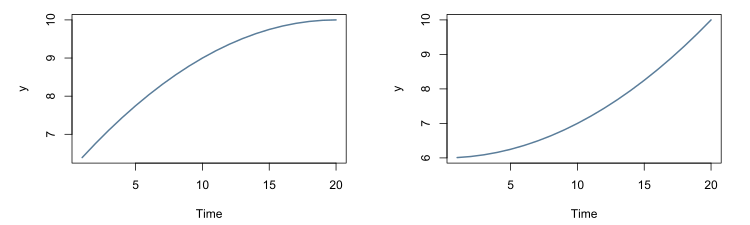
The trend on the right in Figure 1 is created using
\[ y_t = 6 + 0.01 t^2.\] You could thus say that the coefficient for the linear component is zero (i.e., \(b_1=0\)). As there is only a quadratic term here with a positive coefficient, there is an increase over time which accelerates as time continues.
Other combinations of a linear and quadratic term may result in a decreasing trend that slows down over time (and starts to increase if enough time passes by), or a decreasing trend that accelerates as time continues.
2.2 Cubic and quartic terms
Higher-order polynomials allow for more diverse patterns in the trend. Two examples are provided in Figure 2.
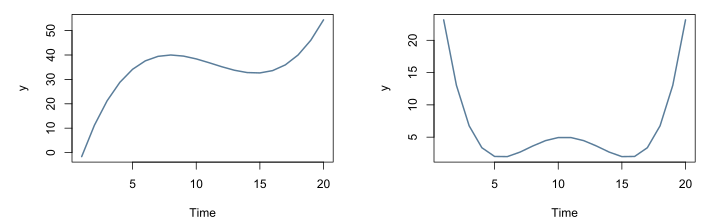
As shown on the left, the inclusion of a third-order term (i.e., \(t^3\)) can result in a trend that changes direction two times (e.g., first increase, then decrease, then increase). When adding a fourth-order term (i.e., \(t^4\)), the direction can change three times, as shown on the right.
3 Other deterministic trends
While the polynomials described above allow for a wide variety of trend shapes, there are also other ways in which \(t\) can be used to construct a trend over time. For instance, you can take the log or the exponential of time; using these you can account for certain growth or decline patterns in the data that are characterized by acceleration or de-acceleration. Examples of this are provided in Figure 3.
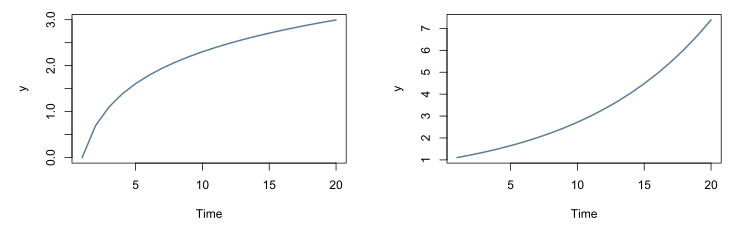
When comparing these trends to the ones in Figure 1, you can see that these may result in somewhat similar patterns over time. This implies that it may be difficult to determine what function of time actually created a particular trend. Moreover, in practice, your data will also contain variation around the trend, and depending on the amount of variation it will be even harder to see the exact shape of the underlying trend.
How to determine whether there is a trend and how to account for it in your analysis, is described later in this article.
4 Using time or centered time
Sometimes it is argued that when you fit a model with polynomials of time, you should first center time. While there may be some computational advantages in doing so, it is important to realize that the overall model does not change when you do this: It is merely a reparameterization of the model.
To see this, you can start with considering a second-order polynomial, that is, a model with a linear and quadratic component. This model can be expressed as
\[ y_t = b_0 + b_1 t + b_2 t^2 + a_t.\]
Suppose you have observed this process for \(T\) occasions; you can now compute the mean of time using
\[ \bar{t} = \frac{1+T}{2}. \]
With this mean of time, you can center time, using \(\tau = t-\bar{t}\). This means that \(t\) can be thought of as the sum of centered time \(\tau\) and the mean of time \(\bar{t}\), that is, \(t=\tau+\bar{t}\).
If you plug this expression for \(t\) into the expression above, you can write
\(\;\;\;\;\;\;\;\;\;\;\;\;\;\;\;\;\;\; y_t = b_0 + b_1 (\tau+\bar{t}) + b_2 (\tau+\bar{t})^2 + a_t\) \(\;\;\;\;\;\;\;\;\;\;\;\;\;\;\;\;\;\;\;\;\;\; = b_0 + b_1 \tau + b_1\bar{t} + b_2 (\tau^2+\bar{t}^2 +2\tau \bar{t})+ a_t\) \(\;\;\;\;\;\;\;\;\;\;\;\;\;\;\;\;\;\;\;\;\;\; = b_0 + b_1 \tau + b_1\bar{t} + b_2 \tau^2+ b_2\bar{t}^2 + b_2 2\tau \bar{t} + a_t.\)
If you now collect all the terms that contain \(\tau\), all the terms that contain \(\tau^2\), and all the ones that do not contain either, you get
\[ y_t = (b_0 + b_1\bar{t} + b_2\bar{t}^2 ) + (b_1 + 2 b_2 \bar{t}) \tau + b_2 \tau^2+ a_t.\]
This shows that if you use centered time \(\tau\) rather than time \(t\), you get: a) an intercept \(b_0 + b_1\bar{t} + b_2\bar{t}^2\) (where all the ingredients—\(b\)’s and \(\bar{t}\)—are constants); b) a coefficient for your linear component that will be \(b_1 + 2 b_2 \bar{t}\) (where again all the ingredients—\(b\)’s and \(\bar{t}\)—are constants); and c) a coefficient for your quadratic component that will be as in the previous formulation (i.e., \(\beta_2\)).
This shows that the model based on centered time \(\tau\) describes the exact same underlying trend as the model using uncentered time \(t\); it just does so using a different parametrization. Moreover, it also shows you that the coefficient for the quadratic term will be the same for these two parametrizations.
The latter generalizes to the \(k\)-th polynomial scenario in that the coefficient for the \(k\)-th component will alsways be the same whether you use time \(t\) or centered time \(\tau\). The other coefficients will change however, although the two parametrizations produce the same trajectory over time.
When considering other deterministic trends, such as logarithms or exponentials, centering time makes a major difference. It fundamentally changes the shape that the model can generate. In these cases it is probably most common to use time \(t\) rather than centered time \(\tau\), as the first only depends on when you started observing the process, whereas the latter depends on both when you started observing the process, and how long you observed it for (i.e., \(T\)); the latter adds an additional arbitrariness to the model you apply.
5 How to detect and account for a deterministic trend
To detect whether there is a deterministic trend in your time series, you may use a regression approach with \(t\) or functions of \(t\) as the predictor(s), and determine whether a specific terms are significant or not. Alternatively, you can use cross-validation to decide whether a particular trend (or trend component) seems useful to capture the underlying patterns in the data; this is particularly common when considering [forecasting] as the primary focus of your analysis.
When there is a deterministic trend in your data, there are two ways of accounting for this when you analyse the data. In the traditional time series literature, the typical suggestion would be to detrend data by subtracting the deterministic trend. This means you have to estimate the trend first using regression techniques, and then obtain the residuals from this for further analysis. Hence, this is essentially a two-step procedure. However, you can also use a one-step procedure. For instance, you can include the trend in an autoregressive moving-average with exogenous inputs (ARMAX) model, by adding time (and/or the necessary functions of time) as exogenous predictors. Similarly, when using a Kalman filter approach based on the state-space model, you can also include (functions of) time as exogenous variables, while also accounting for the short-term dynamics in your model.
In the analysis based on the state-space model, you have a further choice option considering the way in which the deterministic trend is combined with the dynamics. For instance, when you are considering the combination of a deterministic trend and first-order autoregressive (AR(1)) dynamics, you can: a) either specify a model consisting of a trend with autoregressive residuals around it; or b) include the autoregression between the original observations while also accounting for the trend. These two options are mathematically identical, and tend to provide the same results in the long run, albeit based on different parametrizations (see Hamaker, 2005); but in the short run their similarity depends on particular constraints placed on the starting value(s) (see Jongerling & Hamaker, 2011). Hence, while the two formulations may make little difference when dealing with intensive longitudinal data (ILD), it may be quite pivotal when you have panel data.
The advantage of a joint procedure such as the ARMAX model or state-space model is that it will be more efficient (i.e., there is less variance in the parameter estimates) than the two-step approach. Yet, the standard errors of the joint approach may actually be larger than those obtained in the two-step approach based on detrending first. The reason for this is that in the two-step approach, uncertainty that arises in the first part of the approach (i.e., estimating the trend parameters) is not taken into account in the second part of the approach (i.e., when estimating the ARMA parameters of the residuals). Hence, it may seem like the joint approach has less power, because it has larger standard errors; however, this is the result of the two-step approach ignoring inherent uncertainty in other parts of the model and thus being overly optimistic about the precision of its estimates. Based on this, it seems reasonable to prefer a joint approach, in which you estimate the deterministic trend and the autocorrelation structure simultaneously.
6 The meaning of a deterministic trend
When using a deterministic trend in your model, you should always keep in mind that in principle these are just local descriptions or approximations. As such, they may capture specific developmental trajectories that are present for the time that the process was observed, but you should be very cautious in trying to extrapolate this trend beyond the duration of the study, especially if you want to make predictions into the more distant future.
Moreover, when thinking of the substantive meaning of a deterministic trend that is a function of time, it is important to realize that the factor time is probably best thought of as a proxy of some kind of underlying development. That is, it is not time itself that causes changes; rather, developmental processes unfold over time, and maturation and decline happen over time. Therefore, time can be used as a proxy of such processes that may be present in your observed data, or of the factors that drive the changes in your observed data.
The latter concern was elegantly articulated by Baltes et al. (1988), who wrote: “Although time is inextricably linked to the concept of development, in itself it cannot explain any aspect of developmental change […]. Time, rather like the theatrical stage upon which the processes of development are played out, provides a necessary base upon which the description, explanation, and modification of development proceed.” (p.108).
7 Think more about
The deterministic trends that you have read about in this article are a form of non-stationarity. However, there are other kinds of non-stationarity, some of them related to trends as well.
First, the process you are interested in may be characterized by trajectories that changes suddenly over time. Such sudden changes may result from an intervention or an event that took place and that impacted the underlying trajectory. As a result, there may be a sudden change in level or direction of the trend. Such changes can be modeled using a change point model (also known as structural break model, piece-wise regression model, or turning-point model).
Second, rather than a deterministic trends, there may be a stochastic trend, which result from for instance a random walk or an autoregressive intergrated moving average (ARIMA) process. Deterministic and stochastic trends are inherently different, but they may look very similar, especially in the short run. You can read more about this difference, how to distinguish these trends in your data, and how to handle them during analysis in the article about deterministic versus stochastic trends.
Third, your process may also be characterized by patterns that can be thought of as deterministic functions of time that present as systematic, predictable changes that keep repeating themselves over time. Examples are the circadian rhythm, week patterns, month cycles, and annual periodicity. These can be modeled by including sine waves or dummy variables in your model much in the same way as the deterministic trends described in this article (Haqiqatkhah & Hamaker, 2025); the major difference between the two is conceptual, in that trends tend to concern long-term changes in a certain direction, whereas these alternative deterministic features of your process concern lawful, repetitive patterns over time.
Deterministic trends (both smooth or piece-wise), stochastic trends, and repetitive patterns all are forms of non-stationarity. While there are some tests that you can use to determine whether your time series is stationary or not, these tend to test only for whether there is a stochastic trend. It is important to realize that when you use such a test and it indicates that there is no evidence for non-stationarity, this only concerns non-stationarity due to a stochastic trend; it does not inform you about non-stationarity due to deterministic trends or repetitive patterns. To study the presence or absence of other forms of non-stationarity, you will need to perform additional analysis—for instance, running a regression model with time and functions of time as predictors in it to see whether there is evidence for such patterns over time.
8 Takeaway
When you study a process unfolding over time, it may be characterized by a deterministic trend, which can be modeled as a direct function of time. There are many shapes that such a trend can take on; typical ones that are considered are linear, quadratic, logistic, or exponential. Such trends result in long-run increases or decreases in the trajectory.
To study the short-term temporal dependencies in your data, it is important to account for such slow changing features of your process, because they are likely to distort your view of the dynamics otherwise. There are various tests that you can do to determine whether there is a trend in your data, but these tend to focus on one particular kind of trend, and may miss the one that actually characterizes your process. Hence, you may instead decide to include the trend that you consider most likely to be characteristic of the process you are studying into the model that you use to analyze the data.
9 Further reading
We have collected various topics for you to read more about below.
- [Multilevel AR models]
- [Dynamic structural equation modeling]
- [Replicated time series analysis]
- Kalman filter
- State-space model
- Stationarity test
- [Dynamic structural equation modeling]
Acknowledgments
This work was supported by the European Research Council (ERC) Consolidator Grant awarded to E. L. Hamaker (ERC-2019-COG-865468).
References
Citation
@article{hamaker2026,
  author = {Hamaker, Ellen L. and Hoekstra, Ria H. A.},
  title = {Deterministic Trends},
  journal = {MATILDA Preprints},
  number = {2026-01-02},
  date = {2026-01-02},
  url = {https://matilda.fss.uu.nl/articles/deterministic-trend.html},
  langid = {en}
}