
Autoregressive moving-average model with exogenous inputs
This article is about the ARMAX model, which stands for autoregressive moving-average model with exogenous predictors. It is an extension of the well-known class of time series models formed by the autoregressive moving-avarge (ARMA) model. Like the ARMA model, the ARMAX model is concerned with a single observed outcome variable that can be characterized by certain dynamics over time. The extension comes from including other observed variables to explain or predict the fluctuations in the outcome variable. These external variables can be random, but they may also be dummy variables that represent some repetitive pattern (e.g., what day of the week it is), or an intervention.
The X in the name ARMAX stands for one or more exogenous variables, that is, observed variables that affect or predict the outcome variable of interest. Such a variable is exogenous when it is uncorrelated with the current and past residuals (i.e., innovations). There are various models in the N=1 time series literature that can be used to study the relation between an outcome variable and such an exogenous input. These include—in addition to the ARMAX model—the interrupted time series model, dynamic regression, and the change point model. To make an informed decision about which approach is appropriate for your data and research question, it is important to understand what patterns they can capture and to know what their limitation are.
Below you can read more about: 1) the ARMAX model; and 2) the ARMAX model in which the exogenous input represents an intervention.
1 The ARMAX model
This section starts with a short recap of the ARMA model, which forms the basis on which the ARMAX model is built. Subsequently, you can read the ARMAX model with a single concurrent exogenous input variable, and a concurrent and lagged exogenous input. The option of autocorrelation in the exogenous input is discussed at the end of this section.
1.1 The ARMA(\(p,q\)) model
A general expression for the ARMA model is
\[y_t = c + \phi_1 y_{t-1} + \phi_2 y_{t-2} + \dots + \phi_p y_{t-p} + \theta_q \epsilon_{t-q} + \dots + \theta_2 \epsilon_{t-2} + \theta_1 \epsilon_{t-1} + \epsilon_t.\]
where \(c\) is the intercept, \(\phi_1\) to \(\phi_p\) are autoregressive coefficients by which the current outcome is regressed on past versions of itself, and \(\theta_g\) to \(\theta_1\) are moving-average coefficients by which the current outcome is regressed on past random shocks. The final term \(\epsilon_t\) is the innovation or random shock, that is, the part of the current outcome that cannot be predicted from itself or the innovations in the past. These innovations form a white noise sequence, which means that there are no dependencies among them over time.
To understand the extensions discussed below, it is helpful to focus on a simple version of the model. Suppose you are studying daily happiness of an individual, which behaves as an ARMA(1,1) model, that is
\[y_t = c + \phi_1 y_{t-1} + \theta_1 \epsilon_{t-1} + \epsilon_t.\]
This implies that today’s happiness is determined by yesterday’s happiness through the autoregressive term. Moreover, there is a delayed effect of yesterday’s innovation, and there is a new innovation which forms the unpredictable part of today’s happiness. This model is graphically represented in Figure 1.
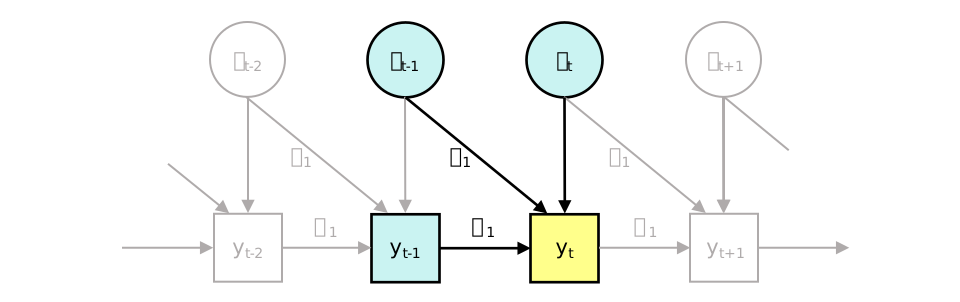
From Figure 1 you can see that the happiness and innovations before yesterday also affect today’s happiness \(y_t\), but only indirectly through yesterday’s happiness \(y_{t-1}\). These effects diminish as the distance in time grows, when \(\phi_1\) lies between -1 and 1: The effect of yesterday’s innovation \(\epsilon_{t-1}\) is \(\theta_1 + \phi_1\); the effect of the innovation the day before yesterday \(\epsilon_{t-2}\) is \((\theta_1 + \phi_1)\phi_1\); et cetera. The constraint on \(\phi_1\) is necessary for the process to be stationary, and to classify as an ARMA process. You can read more about this in the article about the ARMA model.
1.2 ARMAX with a concurrent \(x_t\)
A basic version of the ARMAX model consists of extending the ARMA model above with \(x_t\) as a predictor or exogenous input of \(y_t\). This can be expressed as
\[y_t = c + b_1 x_t + \phi_1 y_{t-1} + \phi_2 y_{t-2} + \dots + \phi_p y_{t-p} + \theta_q \epsilon_{t-q} + \dots + \theta_2 \epsilon_{t-2} + \theta_1 \epsilon_{t-1} + \epsilon_t.\]
When you are studying daily happiness, you want to include external factors that affect a person’s happiness today, for instance, today’s amount of sunshine \(x_t\). For now, assume that there is no autocorrelation in the amount of sunshine; the case of having an autocorrelated exogenous input is discussed later.
The current model can be expressed as
\[y_t = c + b_1 x_t + \phi_1 y_{t-1} + \theta_1 \epsilon_{t-1} + \epsilon_t,\]
where \(b_1\) represents the impact of today’s sunshine on today’s happiness, \(\phi_1\) represents the carry-over of yesterday’s happiness onto today’s happiness, and \(\theta_1\) represents the delayed effect of yesterday’s random shock onto today’s happiness. You can see a graphical representation of this model in Figure 2.
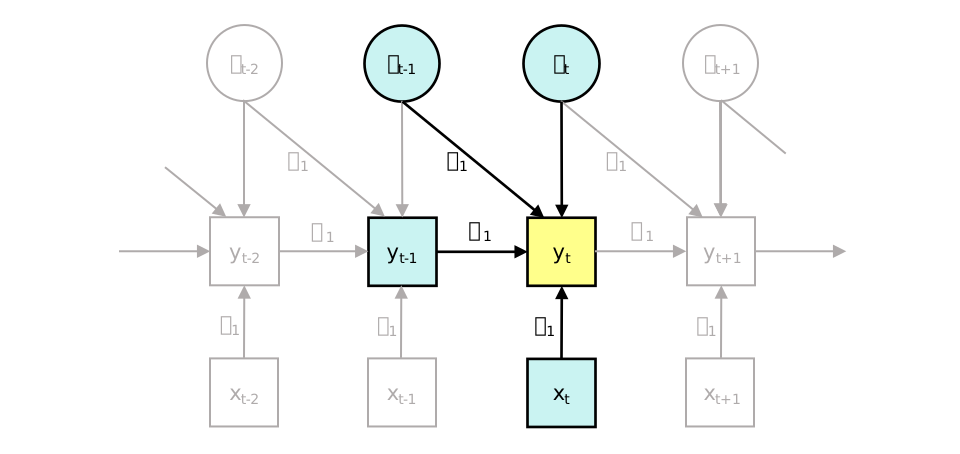
From Figure 2 you can see that today’s happiness \(y_t\) is influenced by today’s sunshine \(x_t\). But yesterday’s sunshine \(x_{t-1}\) also has an effect, albeit indirectly through yesterday’s happiness \(y_{t-1}\); it will be of the size \(b_1\phi_1\).
Junilla is interested in the stress levels a person experiences during the work week and how they unwind during the weekend. She decides to obtain daily diary data about stress, and to use an ARMAX model that includes a dummy variable to indicate whether it is a weekend day or not. She expects stress to be less on the weekend, and thus that the dummy variable has a negative regression coefficient \(b_1\).
Furthermore, Junilla likes the fact that due to autoregression in the ARMAX model there can be some carry-over of Friday’s stress level onto Saturday; this captures her idea that it will take the person some time to wind down after the stresses of a work week. She also likes that there will be carry-over of the low stress on Sunday onto the following Monday; this captures her idea that the relaxation that the person experiences during the weekend, is not immediately gone when the new work week starts.
After obtaining the data, she plots them (with the dummy in dark blue, and stress in pink), and sees this:
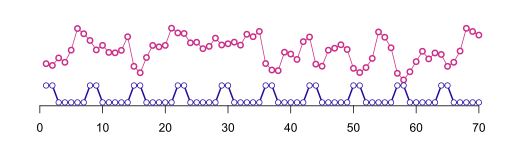
Although it is not immediately clear from looking at these data what the dynamics of daily stress are, Junilla expects to find: a) a negative effect of the dummy variable (representing the weekend) on the stress scores; and b) a positive autoregression for the latter.
1.3 ARMAX with a concurrent \(x_t\) and lagged \(x_{t-1}\)
You may consider the model used above somewhat restrictive, and instead want to also allow yesterday’s sunshine to have a direct effect on today’s happiness. This can be achieved by not only including the concurrent \(x\) as an exogenous input in the model, but also a lagged version of this.
The ARMAX model with \(x_t\) and past versions of this exogenous variable included can be expressed as
\[y_t = c + b_1 x_t + \dots + b_r x_{t-r+1} + \phi_1 y_{t-1} + \dots + \phi_p y_{t-p} + \theta_q \epsilon_{t-q} + \dots + \theta_1 \epsilon_{t-1} + \epsilon_t.\]
When \(r=2\), \(p=1\) and \(q=1\), you get
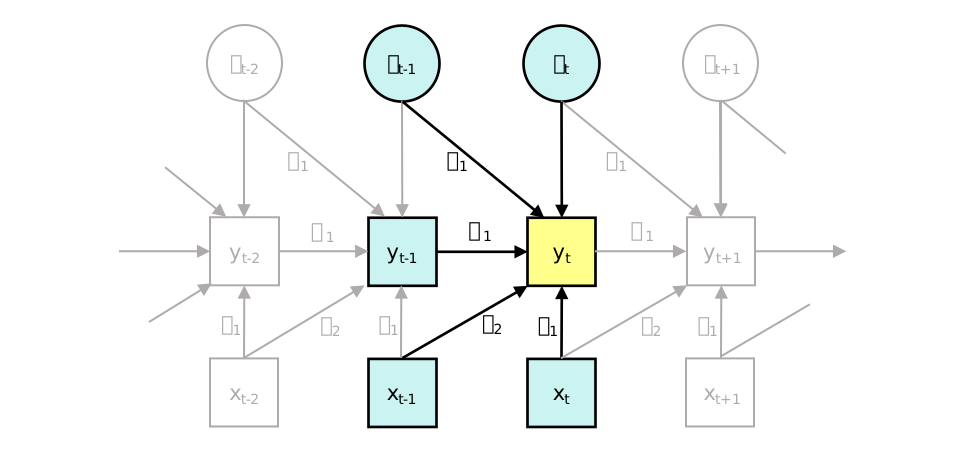
\[y_t = c + b_1 x_t + b_2 x_{t-1} + \phi_1 y_{t-1} + \theta_1 \epsilon_{t-1} + \epsilon_t.\]
This ARMAX model is represented in Figure 3, showing that yesterday’s sunshine \(x_{t-1}\) has both a direct and an indirect effect on today’s happiness, that is, \(b_2\) and \(b_1\phi_1\) respectively.
Of course it is also possible that the exogenous input only has a lagged effect on the outcome variable, and that the concurrent effect is zero. By including both the lagged and concurrent effect in your model, you can investigate whether or not these are present. But you may also base your decisions about whether to include concurrent or lagged relations on theory and on knowledge about how the variables are measured exactly.
For instance, sometimes there is an implicit lagged relation for variables measured at the same occasion, such that the concurrent relation actually represents a lagged relation. For instance, affect may have been measured with a momentary instruction (e.g., how happy are you right now?), whereas another variable was measured with reference to a time frame preceding the current moment (e.g., did something joyful happen in the past hour?). In that case, you may decide to include a concurrent relation in your model, because this represents a lagged relation in reality.
But you may encounter scenarios in which the concurrent relation seems inappropriate for an exogenous input to exert an effect on the outcome. For instance, the effect of taking an aspirin on diminishing one’s headache requires some amount of time between the two (Gollob & Reichardt, 1987); in that case a lagged relation may be more appropriate, although this should also not be too long.
1.4 ARMAX with an autocorrelated \(x_t\)
While the exogenous input(s) are not affected by the outcome variable (e.g., the weather or day of the week are not influenced by a person’s happiness), they may contain some dependencies over time. For instance, today’s amount of sunshine is likely to be correlated with yesterday’s amount of sunshine. Similarly, when you include a dummy variable to indicate whether it was a weekend day or not, this exogenous variable will be characterized by some dependency in the scores on this variable over time.
An example of such dependencies is illustrated in Figure 4, in which the exogenous input itself forms an AR(1) process. It shows that today’s happiness will be related to yesterday’s sunshine in two ways: Through the effect of yesterday’s sunshine on yesterday’s happiness which carries over into today’s happiness (i.e., \(b_1 \phi_1\)); and through the effect of yesterday’s sunshine on today’s sunshine which in turn affects today’s happiness (i.e., \(\kappa_1 b_1\)).
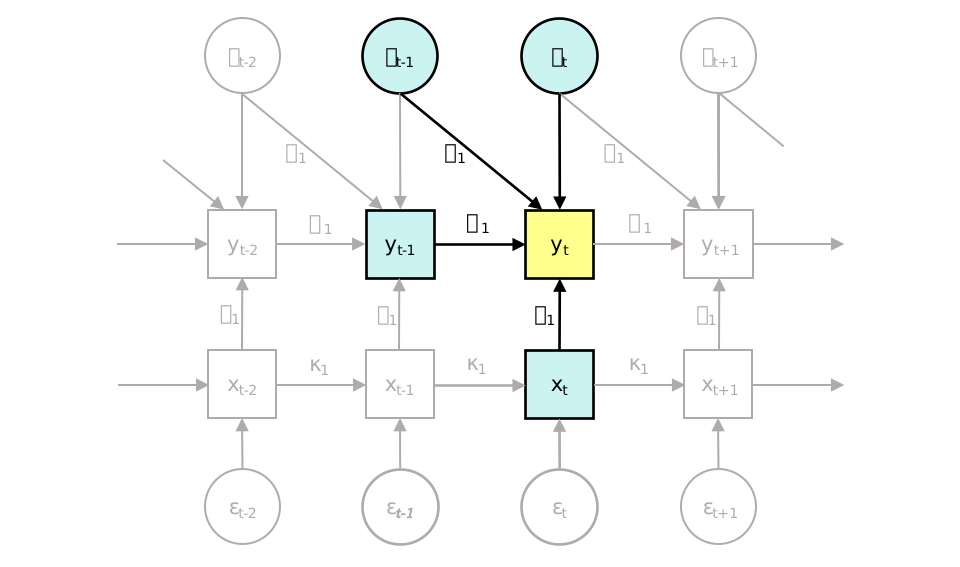
In terms of estimating the effect of today’s sunshine and yesterday’s happiness on today’s happiness (i.e., \(b_1\) and \(\phi_1\)), it does not matter whether or not there is autoregression in the exogenous input. However, if yesterday’s sunshine also had a direct effect on today’s happiness, then it would be important to include \(x_{t-1}\) as well in the analysis; otherwise, the estimation of \(b_1\) would be biased.
An example of a time series generated by the ARMAX model in Figure 4 is provided in Figure 5. Daily hours of sunshine are represented by the dashed green line. Self-reported happiness measured on a 10-point scale is presented by the purple circles. When looking at the patterns of the two series closely, you may notice that the happiness scores tend to follow the changes in daily sunshine; however, this pattern is not very obvious.
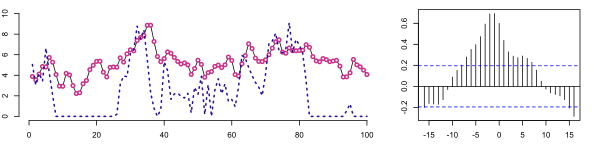
When considering the cross-correlation function plotted on the right of Figure 5, you can see that changes in Sunshine tend to precede changes in Happiness: You can tell by the higher cross-correlations for negative lags, which refer to correlation between earlier Sunshine (e.g., at \(t-1\), \(t-2\), etc., referred to as lags -1, -2, etc. respectively), and current Happiness. In contrast, the positive lags refer to correlations between later Sunshine (e.g., at \(t+1\), \(t+2\), etc., represented as lags 1, 2, etc.).
This finding is somewhat interesting, because in fact, the ARMAX model that was used to generate the data included concurrent sunshine (i.e., \(x_t\)) as the exogenous input, not a lagged version of it; hence, you may have expected the largest cross-correlation at lag 0 (for concurrent Sunshine and Happiness). However, due to the substantial autoregressions for both Sunshine and Happiness (i.e., \(\kappa_1 = 0.9\) and \(\phi_1 = 0.7\)), the unconditional relation between \(X_{t-1}\) and \(Y_t\)—which is quantified by the cross-correlation at lag -1—is larger than the concurrent relation.
This also illustrates that, in general, it is not possible to see from a plotted time series what process generated the data, nor is it possible from plotting two series to see how they depend on each other exactly. To determine whether there is a specific relation between series, or certain dynamics within a series, you have to engage in model estimation, evaluation, and selection.
2 When \(x\) represents an intervention
The exogenous variable \(x\) can be a continuous variable that varies over time according to some random process, either with or without autocorrelation over time. But it is also possible for \(x\) to represent an intervention that is either experimentally or naturally imposed.
It is helpful to distinguish between two categories of interventions in this context: A pulse intervention, which is momentary, restricted to a single point in time, and a press intervention, which is longer-lasting and stretches out across multiple occasions. It is also possible to have a press intervention that is switched on and after some time is switched off again.
You can read more about these three interventions below, and see what kind of patterns they can generate in combination with an ARMA(0,\(q\)), ARMA(1,\(q\)), and ARMA(2,\(q\)) model. Specifically, the focus is on the underlying deterministic trend that results from the various interventions in the various ARMAX models; for clarity and illustrative purposes, the stochastic part, which would result in fluctuations around this trend, is not considered in the plots presented below.
2.1 A pulse intervention
A pulse intervention is represented by an \(x\) variable that consists of 0’s everywhere, except for the one occasion at which the intervention took place. In Figure 6, four examples of a pulse intervention—administered at \(t=40\)—are provided.

The left panel is based on a model without any autoregression (i.e., an ARMAX model with \(p=0\)). The pulse intervention which takes place at \(t=40\) only momentarily leads to an increase here, after which there is an immediate return to the long-run equilibrium. The second panel shows the pulse intervention combined with an autoregression of 0.5. This results in a somewhat gradual return to the long-run equilibrium. The third panel is based on having an autoregression of 0.9, resulting in a much slower return to the long-run equilibrium. The panel on the right is based on an impulse combined with a second-order autoregression process, with \(\phi_1 =1\) and \(\phi_2=-0.5\). This results in an overshooting in the opposite direction and a damping oscillation before settling at the long-run equilibrium.
Vera, Lynn, Bethany and Elske want to study affect regulation in individuals who are exposed to a one-time major stressor. For this they decide to obtain momentary self-reports on tension with experience sampling for two days. During the second day, they subject the participants to a stressful experience: The participants are told that within one hour they must give an online presentation to a group of strangers.
They measure the momentary tension just before the presentation, and then about every fifteen minutes after the presentation. They model the data with a first-order autoregressive (AR(1)) model (correcting for the difference in time intervals between measurement occasions): In this model, the autoregressive parameter is interpreted as a person’s inertia or weakness in affect regulation: The closer this parameter is to 1, the longer it takes the person to recover from perturbations.
By including the intervention as a dummy variable into the AR(1) model, the researchers get an ARX model that allows them to investigate a person’s inertia as well as the effect of the stressor. In their approach, the underlying assumption is that the way the individuals recover from the stressor is the same as the way they regulate their affect when there is no such major stressor. They discuss whether this is a reasonable assumption to make, or whether they should consider another model; in particular, they consider the interrupted time series model, which allows for different dynamics for the intervention than for the ongoing process itself, as an interesting alternative.
This example was inspired by Bouwman et al. (2025).
These are only a few examples, but it allows you to understand some general features of the ARMAX model when \(x\) is a pulse intervention. First, when there is no autoregression, the deterministic intervention effect will be identical to that of the pulse variable itself: It is restricted to that one occasion at which the intervention took place. This is irrespective of the order to the moving-average component of the model.
Second, when the autoregressive component of the ARMAX model is of order 1, then the higher the autoregressive parameter \(\phi_1\) is, the slower the return to baseline after the intervention. Again, it makes no difference whether or not there is a moving-average component in the model.
Third, when the autoregressive component of the ARMAX model is of order 2, more complicated patterns may arise, such as a return to baseline according to a damping oscillator after the intervention. Such behavior is characterized by overshooting both in the negative and the positive direction a few times before settling at the long-run equilibrium again. As with the models above, the moving-average component is irrelevant for this deterministic behavior.
An AR(2) component can give rise to various alternative patterns as well, and need not result in a damping oscillator. You can try this out with the interactive tool for an AR(2) model in the article about the autoregressive model. Moreover, higher-order autoregressive models allow for even more complicated patterns, both within the series, but also for the deterministic effect of a pulse intervention.
2.2 A press intervention
A press intervention is represented by an \(x\) variable that consists of 0’s prior to the intervention, and 1’s after the intervention has started. Such an intervention has also been referred to as a step intervention. In Figure 7 four examples are provided of the deterministic effect of such an intervention, when this is combined with the same four ARMA models as considered for the pulse intervention discussed above.

In the left panel, the ARMAX model does not include autoregression; as a result, the effect of the intervention is a step function and the process immediately settles around its new equilibrium. In the second panel, the onset of the press intervention is gradual, due to the autoregressive effect in the model; yet, it settles at its new equilibrium fairly quickly. In contrast, in the third panel there is a much slower onset, due to the higher autoregression; it seems to take about 40 occasions, before the process starts to settle at its new equilibrium value. In the most right panel, the deterministic pattern is characterized by overshooting the new equilibrium and a damping oscillator before it settles at the new equilibrium value.
As with the pulse intervention, the pattern of a press intervention is only determined by the autoregressive component of the ARMAX model; the moving-average component has no effect on it. Moreover, the pattern depends on the order of the autoregressive component (i.e., here examples of \(p=0,1,2\) are given), and on the values of the parameters.
2.3 A press intervention that is switched on and off
You may also be interested in an intervention that is present for a number of occasions after which it is switched off again. This is sometimes referred to as a multi-period pulse intervention.
In Figure 8 you can see four examples of the deterministic effect of this kind of intervention in an ARMAX model. The intervention is switched on at \(t=20\), and switched off at \(t=55\). Again, the same four ARMAX examples that were used above are considered here: a model without the autoregressive component (left panel), a model with the autoregressive component of order 1 where \(\phi_1=0.5\) (second panel) or \(\phi_1=0.9\) (third panel), and a model with an autoregressive component of order 2 where \(\phi_1=1\) and \(\phi_2=-0.5\).

When comparing the patterns in Figure 8 with those in Figure 7 and Figure 6, you can see that the onset of the intervention effect in the current scenarios is similar to that in the press interventions considered before, whereas the decline after the intervention is finished shows the same pattern as that found for the pulse intervention.
Su is interested in the way the therapeutic effect of training for anger management on emotional control may decline and ware off after the training is finished. He looks into ARMAX modeling for this purpose, but he is concerned that this may not be the right modeling strategy for the pattern he expects to see.
Specifically, Su expects that when the training is over, the effect will remain there for some time, such that it does not immediately start to decline. But after some time, emotional control will start to decline slowly at first, as the person is still able to maintain some of the practices they learned in the training, without the weekly support of the training itself. But after more time has gone by, there is an increasingly more rapid decline, which will then level off at some equilibrium value that may or may not be the same as the equilibrium value the person started out with before the training.
This pattern of slow decline followed by faster decline is actually opposite of the patterns Su sees that can be captured with the ARMAX model. He therefore concludes that the ARMAX model is not the right model for the process he is interested in. Instead, he considers using a change-point model with specific deterministic trends before and after the change point that can actually capture the expected patterns.
2.4 Conclusion
It is clear that the effect of an intervention that can be represented using a dummy variable depends on the autoregression that characterized the process. To obtain a deeper understanding of this kind of behavior in AR models, you can read the articles about displacement of an autoregressive model, and about the regime-switching AR model with a mean or intercept.
3 Think more about
Characteristic of the ARMAX model is that the exogenous input is included as an additional term in the basic ARMA model; its effect over time is therefore determined by the autoregressive component that is present in the model. You may consider this as an attractive feature when you believe that the way a specific exogenous factor (e.g., sunshine or an intervention) affects the system is through the exact same dynamics that also govern the stability of the system when there are no changes in this factor.
However, there may also be scenarios where you consider this feature of the model less attractive or inappropriate for the process you want to study. For instance, when you are specifically interested in the way external factors affects the outcome, you may want to consider an alternative approach known as dynamic regression: In this approach, the exogenous predictors are combined in a regression model with ARMA (Hyndman & Athanasopoulos, 2021). The advantage of this is that the exogenous inputs are separated from the dynamics, and therefore only direct effects exist, which makes it easier to interpret the effects. In this context, Hyndman describes the ARMAX approach as the ``model muddle’’ (see the blog by Rob Hyndman). But this will necessarily result in the patterns that were shown in the most left panels of Figure 6, Figure 7, and Figure 8, where the new equilibrium is reached instantly; when this is not what you expect based on your theory, or based on what you see when you plot the measurements over time, you should consider an alternative approach, for instance one of the following two alternatives.
First, interrupted time series analysis is an approach that was developed by Box & Tiao (1975) specifically to model intervention effects within the tradition of ARMA modeling: While it allows for dynamics in the series through a standard ARMA model, the dynamics that characterize the onset and/or decline of an intervention are included separately. While this modeling approach allows for similar onsets and declines as in the first three panels of Figure 6, Figure 7, and Figure 8, the pattern of this is independent of the ARMA process that is operating prior to and after the intervention. Hence, you can have a very small autoregression in the process itself, and still a slow onset of the intervention effect; or you may have a high autoregression in the process, combined with a quick return to baseline after a pulse intervention.
A second alternative for studying the effect of an intervention is formed by change-point analysis. In this approach, you model the trend prior to and after the change point explicitly using functions of time, rather than dynamics. You may specify a model that allows for fluctuations around a stable mean before and after the intervention started, but you can also specify linear or other trends, both before and after the intervention started. This modeling approach also allows you to specify a particular pattern such as an S-shaped trend (through a sigmoid function) to allow for a slow onset, rapid acceleration, and gradual convergence to a new equilibrium; such a pattern cannot be obtained with an ARMAX model or dynamic regression.
Instead of the pulse and press interventions discussed above, you may have an intervention that is switched on and off frequently over time. For instance, in some of the contemporary experimental designs, such as a micro-randomized trial, the encouragement design, or single case experimental design (SCED), participants are repeatedly exposed and not exposed to an intervention. In theory, the effect of such interventions could also be studied with an ARMAX model, or with one of the alternatives, such as dynamic regression or interrupted time series analysis. However, it may be difficult to determine the dynamics that characterize the onset and decay of an intervention when it switches very frequently: As shown in Figure 6, Figure 7, and Figure 8, there should be enough subsequent occasions to actually realize the full pattern.
4 Takeaway
There are many scenarios in which researchers want to know what the effect is of an exogenous input on an ongoing process. When the latter is characterized by certain dynamics, it is important to take this into account, as it will also have consequences for the way the exogenous input affects the ongoing process. There are various modeling approaches that allow for the inclusion of an external variable in combination with modeling the dynamics of the process. Knowing these and understanding how they differ is essential for being able to make an informed decision on which technique to use in a particular situation.
The ARMAX model is based on including the exogenous inputs as additional terms in the basic ARMA model. You can include one or more external variables, and you can include concurrent and/or lagged versions of this. When there is an autoregressive term in the model, the exogenous inputs will affect later occasions as well. When both the outcome and the input are characterized by substantial autocorrelation, the result of this may be that the two variables show a stronger relation at a lag that is not the one at which \(x\) actually affects \(y\); in practice, this is probably not very common, but it is good to realize this is possible, as it shows the nuance needed when interpreting cross-lagged correlations.
The exogenous input may be a random variable that fluctuates over time, but it may also represent a specific repetitive pattern (e.g., what day of the week it is, or what time of day it is). It may contain autocorrelation—for instance due to the repetitive pattern, or because it is itself a dynamic model; to qualify as exogenous, it is important that it is not correlated with the current or past innovations \(\epsilon\) of the outcome variable \(y\). Hence, if you believe the \(x\) variable is affected by earlier realizations of \(y\), the ARMAX model is not suitable; then, a multivariate approach is more appropriate.
A particularly interesting category of exogenous inputs is formed by dummies that represent an intervention. In the time series literature a distinction is made between pulse interventions that are restricted to a single occasion, and press interventions that stretch out over time. Depending on the specific combination of one of these interventions and the autoregressive component of the ongoing process, the intervention effect can take on different shapes, as shown in this article.
In the ARMAX model the effect of an exogenous input is included in the dynamic part of the model, which implies that the exogenous input variable will have both direct and indirect effects on the outcome, if the latter contains autoregression. The consequences of this are most obvious when you consider the effect of pulse and press interventions: The autoregression results in a gradual onset and gradual decay, or possibly a damping oscillation before a new equilibrium is reached. Although the exact same dynamics are also present when the exogenous input is a naturally fluctuating variable, it is much harder to see this pattern then, because there is not one isolated change for which you can show the deterministic effect.
5 Further reading
We have collected various topics for you to read more about below.
Acknowledgments
This work was supported by the European Research Council (ERC) Consolidator Grant awarded to E. L. Hamaker (ERC-2019-COG-865468).
References
Citation
@article{hamaker2026,
  author = {Hamaker, Ellen L. and Mulder, Jeroen D.},
  title = {Autoregressive Moving-Average Model with Exogenous Inputs},
  journal = {MATILDA Preprints},
  number = {2026-01-02},
  date = {2026-01-14},
  url = {https://matilda.fss.uu.nl/articles/armax-model.html},
  langid = {en}
}