
Interrupted time series model
This article is about interrupted time series modeling or intervention analysis (Box & Tiao, 1975; McDowall et al., 1980). It is a modeling approach that combines the autoregressive moving-average (ARMA) model for N=1 time series data with an intervention that takes place at some point in time and that is expected to impact the ongoing process. The intervention may be experimentally induced by the researcher, but may also occur naturally, in which case the term quasi-experimental design is used. What is critical though is that the timing of the intervention is known; it may concern a pulse intervention, which implies the intervention is limited to one point in time, or a press intervention, which means it is present during a series of consecutive occasions.
Interrupted time series analysis falls within a larger category of techniques that you can choose from when you want to investigate the effect of an intervention on a time series. Other techniques include the autoregressive moving-average model with exogenous inputs (ARMAX model), dynamic regression, and change-point analysis. Understanding the difference between these approaches and the patterns they can and cannot capture, is important if you want to make an informed decision on which method to use when.
Below you can read more about: 1) the two components of the interrupted time series model; 2) various interventions that the interrupted time series model was developed for; 3) various transfer functions these interventions can be combined with; and 4) how the interrupted time series model can be estimated.
1 Two components of the interrupted time series model
The interrupted time series model is based on the autoregressive moving-average (ARMA) model as initially proposed by Box & Jenkins (1970) (for a more recent version, see Box et al. (2016)). If you are not yet familiar with this, you can read up on it in the article about the ARMA model.
The interrupted time series model consists of two independent parts: An intervention component that is a function of the intervention \(I_t\), and a dynamic noise component that forms an ARMA process. Hence, you have
\[ y_t = f(I_t) + a_t\]
where the second term on the right is defined as an ARMA(\(p,q\)) process, that is,
\[ a_t = \phi_1 a_{t-1} + \dots + \phi_p a_{t-p} + \epsilon_t + \theta_1 \epsilon_{t-1} + \dots + \theta_q \epsilon_{t-q}.\]
Here, the \(\phi\)’s are the autoregressive parameters by which the current \(a_t\) is regressed on earlier versions of itself. The term \(\epsilon_t\) represents the unpredictable part of \(a_t\): It is referred to as the random shock or innovation at occasion \(t\), and it captures all the momentary influences of external (and unobserved) factors on \(a_t\). The innovations are uncorrelated over time, forming a white noise sequence with mean zero and variance \(\sigma_\epsilon^2\). The \(\theta\)’s are the moving-average parameters by which the current \(a_t\) is regressed on past innovations; this allows for a delayed effect of the external factors on \(a_t\).
The intervention component \(f(I_t)\) is referred to as the transfer function by Box & Tiao (1975). Before considering the various transfer functions that you can choose from, it is helpful to first know about the various interventions that this method was developed for.
2 Various interventions \(I_t\)
There are two kinds of interventions that the current method was developed for: a pulse intervention, which takes place at a single point in time, and a press intervention, which starts at a particular occasion and then persists over time. A third intervention that may be of interest is one that is switched on and lasts for some occasions before it is switched off again. This could be described as a press intervention that is switched on and is then turned off again; in the time series literature it has also been referred to as a multi-period pulse intervention.
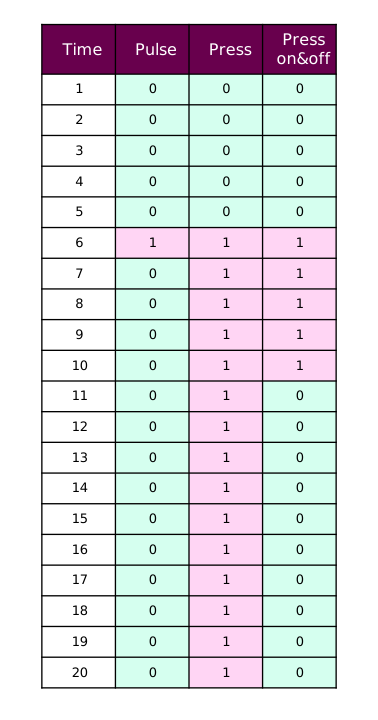
Each of these interventions can be easily represented by a dummy variable, as shown in Figure 1. In the first column you see time; this shows that each of the three interventions starts at occasion 6. The pulse intervention is represented by a 1 at occasion 6, and 0’s everywhere else. The press intervention is characterized by 0’s prior to occasion 6, and from occasion 6 onward by 1’s. The press intervention that is turned on and off is characterized by 0’s prior to occasion 6; between occasion 6 and 10, it is characterized by 1’s; and from occasion 11 onward it is characterized by 0’s again, to capture that the intervention has stopped.
There may be scenarios also where you want to combine both a pulse and a press intervention in your analysis; this allows for further flexibility in the kinds of patterns that can be generated, as will be shown below.
Waldo studies working memory by asking people to remember random sequences of digits. He believes that the performance of people does not fluctuate randomly over time, but that it is actually determined by how well a person is able to focus, which also varies over time. Waldo assumes that this results in autocorrelation in the performance over time, which he can capture with autoregression when modeling the performance measure.
Waldo is especially interested in how chunking the digits into meaningful groups improves performance compared to trying to remember them one by one. He therefore starts his experiment with a number of trials on which the participant is simply asked to memorize the sequences. After several of such trials, he explains how chunking can help to memorize such sequences, and then another series of trials follows.
Waldo wonders what dummy variable he should use to represent this intervention. Initially, he thought of it as a pulse intervention, as it only takes place once during the series of trials. But on second thought, Waldo believes it should be considered a press intervention, because once a person is taught this strategy, it is basically impossible to unlearn it: As it is an easy and powerful strategy for memorizing sequences of digits, it is very likely that a person keeps using it on every trial after the intervention. Hence, Waldo decides to represent the intervention as a press intervention in his analysis. But he also considers including the pulse variable as well to allow for more flexibility in the patterns that he can capture; he wants to evaluate the usefulness of the latter extension by considering the significance of the regression parameter for the pulse dummy.
3 Different transfer functions
Each of the interventions described above can be combined with various transfer functions. Given the expression \(y_t = f(I_t) + a_t\), you can also write: \(f(I_t) = y_t - a_t\). For ease of presentation, the transfer function is written as \(f(I_t) = \eta_t\).
Below you can first read about a transfer function that results in a sudden onset and/or sudden decay, followed by a transfer function that results in a gradual onset and/or decay. Finally, some other options for the transfer function are presented.
3.1 Sudden effects
The intervention—whether a pulse or press—is represented by an observed dummy variable \(I_t\), which consists of 0’s when there is no intervention, and 1’s at the occasions that the intervention is present. A basic transfer function is
\[ \eta_t = \omega I_t,\]
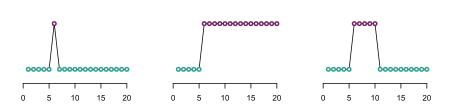
which results in a sudden change of size \(\omega\) at the time of the intervention. If \(I_t\) is a pulse intervention, the effect is immediately gone after the pulse. When there is a press intervention, the effect \(\omega\) remains for the duration of the press intervention. These patterns are visualized in Figure 2.
This particular version of the interrupted time series model can actually also be thought of as dynamic regression; while it allows for handling the effect of the exogenous input (i.e., \(I_t\)) separately from the dynamics that characterize the ongoing process, the effects are very simplistic, in that they are either switched on (when \(I_t=1\)) or switched off (when \(I_t=0\)).
More subtle versions of the interrupted time series model that allow for dynamics in the onset and decay are presented below; these cannot (so easily) be captured with dynamic regression, and thus are better specified within the current modeling framework.
3.2 Gradual effects
To allow for a more gradual onset and/or decay of the intervention effect, you can adapt the transfer function to include an autoregressive term, that is
\[ \eta_t = \delta \eta_{t-1} + \omega I_t.\]
The autoregressive parameter \(\delta\) accounts for dynamics in the transfer. Note that when \(\delta=0\) the expression above reduces to the expression that was given above for sudden effects; hence, the transfer function for sudden effects is a special case of the current transfer function.
When you have \(0<\delta<1\), this results in the following patterns when combined with the three different interventions. In case of a pulse intervention there is a sudden onset of size \(\omega\), after which there is a gradual decay. This is visualized on the left panel of Figure 3.
When this transfer function is combined with a press intervention, it results in a gradual onset of the intervention effect, as shown in the middle panel of Figure 3. The parameter \(\omega\) represents the initial effect at the start of the intervention, but the intervention effect grows further over time to the level of \(\omega/(1-\delta)\).
When the press intervention is first switched on and after some time is switched off again, this results in the combination of a gradual onset and a gradual decay, as shown in the right panel of Figure 3. Again, the parameter \(\omega\) represents the increase at the first occasion of the intervention, and the transfer function continues to climb after that to the level \(\omega/(1-\delta)\). However, whether this new equilibrium level is actually reached depends on how long the intervention remains active. When the intervention stops, the process returns gradually to its original baseline.
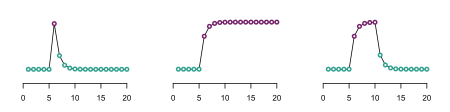
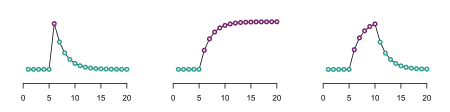
In the transfer functions in Figure 3 the autoregressive parameter \(\delta\) was set to 0.3. This parameter determines how fast the new equilibrium—either when starting a press intervention, or stopping an intervention—is reached. This becomes clear when comparing the patterns from these transfer functions to the ones obtained with \(\delta=0.6\), as shown in Figure 4.
The parameter \(\delta\) determines how gradual the impact and/or return to baseline is, and—in case of a press intervention—what the new equilibrium value is. To understand this behavior, it may help to consider the path diagram of an interrupted time series model as shown in Figure 5. It depicts occasions 4 to 7 of a process \(y_t\) that is formed by the sum of a transfer function and—in this case—ARMA(1,1) noise. Up to occasion \(t=5\), there is no intervention, such that \(I_4=0\) and \(I_5=0\); this implies the transfer function is 0 up to \(t=5\). But from occasion \(t=6\) onward, the intervention is active, as indicated by \(I_6=1\) and \(I_7=1\); this results in a cumulative effect of the intervention.
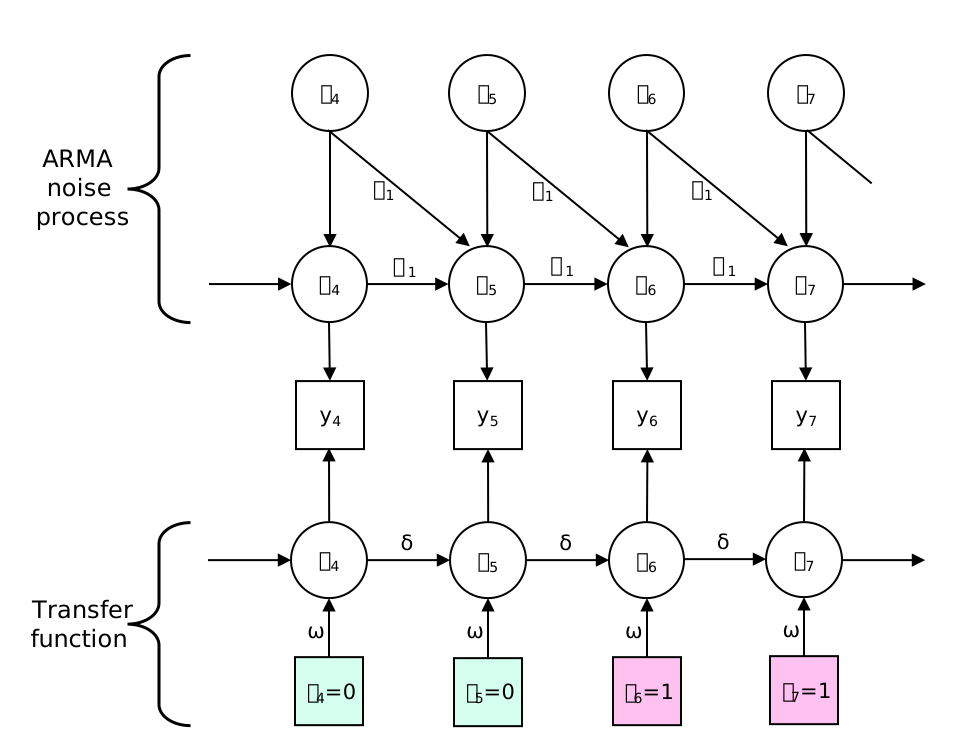
Based on this, you can also see what the onset of the intervention will do for \(y_t\). For \(t=4\) and \(t=5\), you get
\(\;\;\;\;\;\;\;\;\;\;\;\;\;y_4 = a_4\)
\(\;\;\;\;\;\;\;\;\;\;\;\;\;y_5 = a_5.\)
At \(t=6\) the intervention starts, and as a result
\(\;\;\;\;\;\;\;\;\;\;\;\;\;y_6 = \omega + a_6\)
\(\;\;\;\;\;\;\;\;\;\;\;\;\;y_7 = \omega + \delta \omega + a_7.\)
This will continue with
\(\;\;\;\;\;\;\;\;\;\;\;\;\;y_8 = \omega + \delta \omega + \delta^2 \omega + a_8\)
\(\;\;\;\;\;\;\;\;\;\;\;\;\;y_9 = \omega + \delta \omega + \delta^2 \omega + \delta^3 \omega + a_9\)
and so on. It shows that as time continues, the intervention component becomes \(\omega (1+\delta +\delta^2 +\delta^3 + \dots)\). When \(0<\delta<1\), this is known as a geometric series that converges to \(\omega/(1-\delta)\); this is the long-run new equilibrium of a press intervention.
3.3 Alternative transfer functions
There are various alternative transfer functions. A particular one that is often discussed in the interrupted time series literature is when the autoregressive parameter \(\delta\) takes on the value 1. This results in what has been referred to as a ramp: Rather then growing towards a new equilibrium, this results in a linear increase with a slope of \(\omega\).
It may also be of interest to combine the pulse and the press variables in the transfer function, that is
\[ \eta_t = \delta \eta_{t-1} + \omega_1 Pulse_t + \omega_2 Press_t .\]
In this approach the initial effect at the start of the intervention is \(\omega_1 + \omega_2\). Subsequently, there is a gradual decay, governed by \(\delta\): When \(\delta\) is close to 0, the decay is fast; the closer it is to 1, the more gradual the decay. The process settles at a new equilibrium, which is formed by \(\omega_2/(1+\delta)\).
Zlata studies positive affect in a student who is waiting for the results of their final exam. She assumes that when the student finds out they passed the exam, there will be a major spike in their happiness, which will linger somewhat, although it will not remain as high as during the initial realization. Hence, a pulse intervention seems more appropriate than a press intervention.
Yet, Zlata also expects that the average level of happiness after the positive result will be higher then during the anticipation phase. Hence, she decides the combine the pulse intervention with a press intervention in the transfer function. She likes that a positive \(\delta\) implies there is some carry-over of the initial effect of the positive news, while a positive \(\omega_2\) indicates that the long-run equilibrium after the pulse intervention is different than that before the news came.
You can see three examples of this in Figure 6: The difference between these transfer functions is determined by the size of \(\delta\), which increases from 0.3 (left panel), to 0.6 (middle panel), to 1 (right panel).
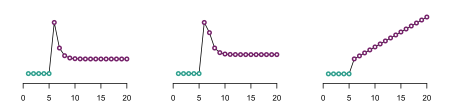
The left and middle panel show examples of an initial strong intervention effect, which wears off to some extent, although some effect remains due to the inclusion of the press intervention variable. The right panel shows an initial jump followed by an ever increasing effect: Because \(\delta =1\) here, the process does not converge to a new constant.
Again, you can consider the previous transfer functions as special cases of the current one. When either \(\omega_1\) or \(\omega_2\) is equal to zero, you have the transfer functions for gradual effects. If additionally, \(\delta=0\), you get the sudden effects.
Malika measures the daily physical activity of a person prior to and after getting surgery that is intended to improve their mobility. She is not sure whether there will be autogression in physical activity in the absence of an intervention; to be sure, she decides to account for this in her model through specifying a first-order AR model for the non-intervention part \(a_t\).
At the day of the intervention, Malika expects a large decrease in physical activity, which then carries over to the following days although it decrease becomes a little less every day. Moreover, she expects that over time, physical activity will not only reach the level it had before the intervention, but actually exceeds this and settles at a new, higher level than before.
Hence, Malinka will use a transfer function with autoregression and both a pulse and a press intervention. She expects the initial intervention effect \(\omega_1 + \omega_2\) to be negative, and \(\delta\) to be positive resulting in an exponential upward trajectory after the initial drop. Moreover, she expects the new equilibrium \(\omega_2/(1+\delta)\) to be higher than the equilibrium before the intervention; hence, she expects \(\omega_2\) to be positive.
3.4 In conclusion
While the explanation and examples provided above focused exclusively on interventions that lead to an increase in \(y_t\), it is equally applicable to interventions that result in a decrease. For instance, a mindfulness intervention may reduce stress, and an alcoholic beverage may diminish social inhibition. In such scenarios, there may be an abrupt or more gradual decrease in the outcome when a press intervention starts, or a more abrupt or gradual increase towards the initial baseline or a new equilibrium when the intervention is stopped.
4 Estimation of an interrupted time series model
Estimation of the interrupted time series model is most naturally done using a state-space formulation of the model combined with the Kalman filter to obtain maximum likelihood estimates. The state-space framework is based on two equations, that is, the measurement equation and the transition equations. If you want to estimate an interrupted time series model, you need a state-space framework that allows for the inclusion of exogenous observed variables in the transition equation.
The state-space modeling approach allows for the combination of various transfer functions \(f(I_t)\) (based on various interventions \(I_t\)), and various ARMA(\(p,q\)) noise components. You can read more about how to specify ARMA(\(p,q\)) models in the article about state-space modeling. Below, a few basic examples are provided, to give you an impression of how interrupted time series modeling can be achieved in this framework.
4.1 Pulse or press intervention with AR(1) noise in state-space format
To combine a pulse or press intervention with ARMA(1,0) noise, you should specify the measurement equation of the state-space formulation as
\[ y_t = \eta_t + a_t = [1 \;\;\;\ 1] \begin{bmatrix} \eta_t \\ a_t\end{bmatrix}.\]
This is then combined with the transition equation
\[\begin{bmatrix} \eta_t \\ a_t\end{bmatrix} = \begin{bmatrix} \omega \\0\end{bmatrix} \begin{bmatrix} I_t \end{bmatrix} + \begin{bmatrix} \delta & 0\\0&\phi_1\end{bmatrix} \begin{bmatrix} \eta_{t-1} \\ a_{t-1}\end{bmatrix} + \begin{bmatrix} 0 \\ \epsilon_t \end{bmatrix},\]
which results in \(\eta_t = \omega I_t + \delta \eta_{t-1}\) to represent the intervention component, and \(a_t = \phi_1 a_{t-1} + \epsilon_t\) to represent the AR(1) noise component (i.e., the ongoing process).
4.2 Pulse and press intervention with AR(1) noise in state-space format
If you want to include both a pulse and a press intervention with an ARMA(1,0) process, you should specify the measurement equation in the same way as for the previous example. The transition equation now needs to be specified as
\[\begin{bmatrix} \eta_t \\ a_t\end{bmatrix} = \begin{bmatrix} \omega_1 & \omega_2 \\0 & 0\end{bmatrix} \begin{bmatrix} Pulse_t \\ Press_t \end{bmatrix} + \begin{bmatrix} \delta & 0\\0&\phi_1\end{bmatrix} \begin{bmatrix} \eta_{t-1} \\ a_{t-1}\end{bmatrix} + \begin{bmatrix} 0 \\ \epsilon_t \end{bmatrix},\]
which results in \(\eta_t = \omega_1 Pulse_t + \omega_2 Press_t + \delta \eta_{t-1}\) for the intervention component, and \(a_t = \phi_1 a_{t-1} + \epsilon_t\) for the noise component.
4.3 Pulse or press intervention with ARMA(1,1) noise in state-space format
While AR(1) noise is easily managed with the transition equation, ARMA(1,1) noise is a bit more challenging. It requires you to maintain the innovation \(\epsilon_t\), so it can be used as a predictor for the next occasion. The measurement equation now becomes
\[ y_t = \eta_t + a_t = [1 \;\;\;\ 1 \;\;\; 0] \begin{bmatrix} \eta_t \\ a_t\\\epsilon_t\end{bmatrix},\] with the accompanying transition equation being
\[\begin{bmatrix} \eta_t \\ a_t \\ \epsilon_t \end{bmatrix} = \begin{bmatrix} \omega \\0\\0\end{bmatrix} \begin{bmatrix} I_t \end{bmatrix} + \begin{bmatrix} \delta & 0 & 0\\0&\phi_1 & \theta_1 \\ 0 & 0 & 0\end{bmatrix} \begin{bmatrix} \eta_{t-1} \\ a_{t-1} \\ \epsilon_{t-1}\end{bmatrix} + \begin{bmatrix}0&0&0\\0&1&0\\0&1&0\end{bmatrix} \begin{bmatrix} 0 \\ \epsilon_t \\ 0 \end{bmatrix}.\] which gives you \(\eta_t = \omega I_t + \delta \eta_{t-1}\) for the intervention component, and \(a_t = \phi_1 a_{t-1} + \theta_1 \epsilon_{t-1} + \epsilon_t\) for the noise component.
4.4 To conclude
There are various ways to estimate the interrupted time series model. Some of the older works on this modeling approach present estimation procedures that do not involve the state-space model and Kalman filter. In this alternative approach, you first reformulate the model such that it includes the autoregressions for the observed series, rather than for its residuals; this results in an expression based on an infinite sum of past components, which can then be approximated with a finite sum; this will result in some bias, although it may be managed by not dropping too many past components.
The primary reason for this alternative approach seems to be that state-space modeling and the Kalman filter were less common back then. However, nowadays, there are many software packages that allow you to estimate state-space models, and there is no need for the alternative estimation procedure any more.
5 Think more about
The interrupted time series model discussed in this article is a way to combine the dynamics of an ongoing process with an intervention that is imposed at some moment in time. There are various alternative modeling approaches that you can consider for this purpose as well, most notably, the ARMAX model and dynamic regression. These two approaches were not specifically developed to study the effect of interventions; they are more generally meant to combine the basic ARMA model with exogenous variables. Yet, the latter can be dummies that represent interventions.
In comparison to the ARMAX model, the interrupted time series model stands out because it does not mix the intervention with the dynamics of the ARMA process; instead, it allows the intervention to have its own dynamics. As a result, the gradual onset or decay of an intervention effect are independent of the dynamics that characterize the ongoing process. The current approach is therefore more flexible in that it can capture more diverse patterns; but it may also be harder to estimate in practice, because there tends to be relatively little information in the data that supports the estimation of \(\delta\). Especially when you have this combined with both a press and a pulse intervention dummy, there may be a lot of uncertainty in the parameter estimates—resulting in large confidence or credibility intervals around them and little power to determine they are different from zero. Just having more time points will not help then: What you would need is more densely spaced observations during the time that the dynamic effect of the intervention is playing out. Careful theorizing about this—how long do you think it takes before the intervention effect has fully settled—is therefore an important step to increase your chances of getting data that contain the information such a model needs.
In comparison to dynamic regression, the defining feature of interrupted time series modeling is that it allows for the intervention effect to exhibit dynamics. Like interrupted time series modeling, dynamic regression is also based on separating the dynamics of the ongoing process from the effect of the exogenous predictors, but the latter are simply included in the model without the autoregressive term; hence, you can think of dynamic regression analysis with dummies that represent interventions as interrupted time series analysis with \(\delta = 0\); hence, the patterns that can be capture by this are as shown in Figure 2. You may extend the model with lagged versions of the intervention variable, but to mimic the dynamic onset or decay that naturally stems from the interrupted time series model discussed here is challenging.
Another model that may be considered as an alternative for investigating the effect of an intervention is the change-point model. This approach typically does not include any dynamics; instead, the main focus is on explicitly modeling the underlying temporal trajectory using time \(t\) and/or functions of time, such as \(t^2\) or \(\log(t)\). It allows for alternative patterns in the onset and/or decline and can for instance accommodate a pattern in which the onset is slow at first, followed by an acceleration after which it levels off at a new equilibrium. However, you have to explicitly specify such a sigmoid pattern, and it may be challenging to figure out when this is supposed to start and when it ends.
Finally, you should be cautious not to interpret the results obtained with the interrupted time series model—or with one of its alternatives—too easily as reflecting causal effects of the intervention. While the approach was developed for this purpose, you have to be wary of the possibility that a third, unobserved variable is the actual reason for a relation between your intervention variable \(I_t\) and the outcome \(y_t\). This is especially true in case of quasi-experimental designs, where the intervention occurred naturally, but even when the timing of the intervention was decided by the researcher, it may still be the case that other developments that took place over time and that the intervention variable happens to be correlated with, form the real trigger of a change in the outcome.
Bo wants to know whether the hyperactivity of children diagnosed with ADHD can be successfully reduced with medication. She is particularly interested in determining whether this is successful for individual children, rather than at the group level. She therefore asks the parents of a child with ADHD to fill out a short questionnaire at the end of each day to report on their child’s hyperactive behaviors that day.
From the start of the study, the child is given a daily dose of pills. During the first phase of the study, these pills contain no active ingredient, and are thus a placebo. At some random point in time, the placebo is replaced by pills that contain an active ingredient. When Bo analyzes the data afterwards, she finds no evidence for a beneficial effect of the treatment. In fact, it seems like the medication made the hyperactivity worse. She is surprised by this result, as she expected the medication to reduce the hyperactive behavior, or to have no effect on it, but not to amplify it.
But then Bo realizes that the start of the medication phase coincided with the arrival of Sinterklaas in the Netherlands: This is a traditional children’s celebration which lasts about three weeks, during which period children tend to be very excited. Hence, the increase in hyperactivity may well be the result of this. It is even possible that the medication was effective in reducing the hyperactivity in this child, albeit not to the degree that the Sinterklaas-effect increased it. To find out, Bo decides to repeat the study during a less exciting period.
6 Takeaway
Interrupted time series modeling is a technique that was developed to allow for the dynamic onset and decay of treatments, which operates independently of the dynamics that govern an ongoing process. It is a technique that is appropriate for investigating the effect of pulse interventions, which take place at a single isolated occasion, as well as press interventions, which take place over longer stretches of time. Additionally, you may also have a press intervention that is switched off after some time, or you can combine a pulse and press intervention to allow for further flexibility in intervention patterns over time.
Typical of the patterns though is that the increase or decrease is rapid at first, and then tends to level off. This implies that if you expect other temporal patterns due to the initiation or termination of a treatment, the current modeling approach is not appropriate and you should consider another modeling approach instead. Possible alternatives in that case are change-point analysis and dynamic regression; yet, these require you to explicitly model the shape you expect from the intervention.
When interpreting the effect of an intervention in causal terms, you should always be cautious of possible confounders, that is, common causes of your outcome variable and the intervention variable. Even when you (experimentally) decided when the intervention started, this does not rule out the possibility that there is a relation between the treatment variable and the outcome merely because of time. Other experimental designs may provide more convincing evidence in this situation.
For instance, there are designs in which the results from single case studies are combined across cases to increase the power; however, this tends to shift the focus from the individual effect to an effect averaged across individuals. Another possibility is to switch repeatedly between treatment and no treatment, using what is known as an ABAB or multiple baseline design. This allows for the replication of baseline and treatment phases within a person over time. However, this is only possible when the intervention can be switched off again. Moreover, it also requires careful consideration of the duration of carry-over of the treatment effect after the treatment is terminated (i.e., the speed of decay of the treatment effect); this is often referred to in the medical literature as the wash-out period.
7 Further reading
We have collected various topics for you to read more about below.
Acknowledgments
This work was supported by the European Research Council (ERC) Consolidator Grant awarded to E. L. Hamaker (ERC-2019-COG-865468).
References
Citation
@article{hamaker2026,
  author = {Hamaker, Ellen L. and Mulder, Jeroen D.},
  title = {Interrupted Time Series Model},
  journal = {MATILDA Preprints},
  number = {2026-01-02},
  date = {2026-01-14},
  url = {https://matilda.fss.uu.nl/articles/interrupted-time-series-model.html},
  langid = {en}
}