
MATILDA’s Model Navigator: Its purpose, focus, defining questions, and final categories
MATILDA’s Model Navigator is developed as a supporting tool that you can use if you want to learn more about dynamic modeling of intensive longitudinal data (ILD), or if you want help in deciding what models may be most useful in your empirical study. It focuses on univariate N=1 time series models, which form the building blocks for many multivariate and/or \(N>1\) modeling techniques.
The Model Navigator is based on three questions about the dynamics you expect to characterize the process that you want to study. These expectations can be based on the theory you have, or on the patterns you believe to be present in the intensive longitudinal data (ILD) you have. When you theorize about the temporal patterns that characterize a process, this very much depends on what data collection method you used or plan to use (e.g., whether you use self-reports, mobile sensing, or another technique), as well as the temporal design you use or plan to use (e.g., how often you measure, how densely spaced in time your measurements are, and for how long you observe the process). Using MATILDA’s Model Navigator as a supporting tool in decision making thus requires you to bring together the four key components: theory, measurement and analysis, in the context of your study.
In this article you can read more about: 1) the purpose of MATILDA’s Model Navigator; 2) the focus on univariate \(N=1\) models; 3) the three key questions underlying the Model Navigator; and 4) the five categories these questions ultimately distinguish.
1 Purpose
The purpose of MATILDA’s Model Navigator is two-fold:
First, the Model Navigator can be used as a didactic tool to help you learn more about diverse dynamic models, to develop intuition about the dynamic patterns these diverse models can generate and how these patterns depend on particular parameters of the model, and to gain deeper insight into how different models are related to each other.
Second, the Model Navigator can be used as a decision-supporting tool to help you find the most promising models for your study, depending on the kind of data you have and the theory you have about the process you try to capture with these data.
MATILDA’s Model Navigator is based on models that are well known and have been described and studied extensively in the time series literature. While there is already a lot of literature on these models, especially in econometrics, the existing presentations are not always easy to understand for researchers from other disciplines: It tends to require familiarity with the field’s jargon and often builds on assumed prior knowledge.
To complement the existing time series literature, MATILDA’s Model Navigator was developed with a psychologist in mind, aiming to connect with their typical interests, prior knowledge, and frame of reference, to make these models and the ideas they are based on accessible for an audience of psychological researchers.
2 Focus
MATILDA’s Model Navigator focuses on univariate \(N=1\) models. These models can be thought of as the fundamental building blocks of multivariate models and \(N>1\) techniques. Hence, developing a thorough insight in the kind of patterns that arise from particular model features in the univariate \(N=1\) context and how changes in a particular model parameter alters the behavior of the process that is generated, helps you to get a better appreciation of dynamic modeling in general.
2.1 Univariate versus multivariate
The focus on univariate models implies that there is a single outcome variable; this can be combined with multiple exogenous variables, that is, observed variables that serve as predictors in the model. Some of the models included in the Model Navigator contain time or a function of time as a predictor of \(y\). Moreover, there are also models that include exogenous predictors that themselves are processes that fluctuate randomly over time or according to some predetermined pattern (e.g., being at work or not, or whether it is a day on the weekend or not). Additionally, models may include a dummy variable that represents the presence or absence of some kind of intervention or condition that varies over time. Such models thus require multivariate data; yet, the term univariate refers to having a single outcome variable.
For most—if not all—of the models that are included, multivariate extensions exist. The behaviors of such multivariate models can be much more complex than those of their univariate counterparts. Hence, learning about the patterns that univariate models can generate is important, but you should consider this only a first step: The more variables there are in a system, the more complex its temporal behavior can be.
2.2 \(N=1\) versus \(N>1\)
The Model Navigator places the focus on \(N=1\) time series modeling: This is considered relevant for actual \(N=1\) studies, but also for \(N>1\) studies. In the latter case, the interest is often on investigating similarities and differences between cases (i.e., individuals or dyads); this can be done in various ways when you go from N=1 to N>1.
It is important to keep in mind that the case you study can be an individual, but that it can also be another entity, for instance a dyad or a team. In combination with the univariate focus, this implies that you may consider as the outcome for instance the current physical distance between two individuals, or the amount of collaboration over the past day between team members. As predictors you may then consider other characteristics of the case, including the behavior and experiences of individual members of the dyad or team.
3 Defining questions
There are three defining questions on which MATILDA’s Model Navigator is built. The first question is: Is there change or no change? If your answer to this first question is that the process you are interested in is characterized by change, then there are two additional questions: Is change sudden or smooth? And: Is change lasting or reversible?
Below, you can read more about these three questions.
3.1 Question 1: Is there change or no change?
While processes tend to be characterized by fluctuations, which can be referred to as variability, not all processes are characterized by change: The latter implies variation that is typically slower and longer-lasting than the momentary fluctuations. Change may show up as an underlying trajectory that represents growth or decline. But there may also be change in other process aspects, such as the amount of variability which may increase or decrease over time, or the temporal dynamics, such that the predictability and structuredness of the process changes over time.
In MATILDA’s Model Navigator, the qualification change is considered appropriate if one or both the following conditions hold:
the process is non-stationary; and/or
parameters of the underlying process vary over time.
Hence, you have four options here, as shown in Figure 1.
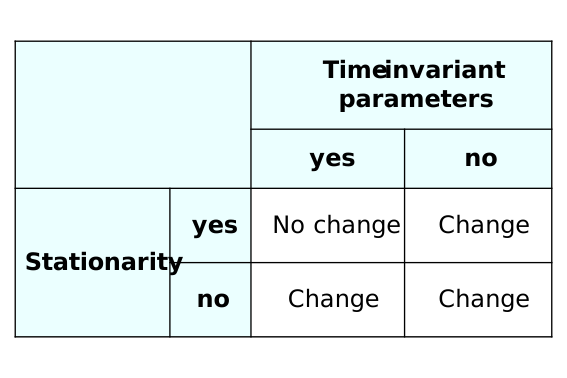
Processes that fall in the no change category thus have to be stationary and have parameters that are invariant over time. Common examples of this are the autoregressive moving-average (ARMA) model, and its specific cases, that is, the autoregressive (AR) model and the moving-average (MA) model.
As Figure 1 shows, the change category encompasses models that are characterized by non-stationarity, time-varying parameters, or both. Typical examples of non-stationary models and whose parameters are time-invariant are models that include a deterministic trend (e.g., an increasing or decreasing tendency over time), or a regularly repeating pattern (e.g., a sine wave or a work day versus weekend pattern). Another major class of models that falls into this category are known as unit root processes, like a random walk.
Examples of models with time-varying parameters are regime-switching models, which are characterized by alternating between two or more distinct states that each have their own parameters. These include the Markov-switching autoregressive (MS-AR) model or the threshold autoregressive (TAR) model. While such models are in principle stationary (unless there is an absorbing state), the parameters that generate the data are not the same over time; as a result, their mean, variance and dynamics may change over time, which is why these processes are classified under change within the Model Navigator.
There are also models that meet both criteria for change. Specifically, the time-varying autoregressive (TV-AR) model has parameters that vary over time (i.e., the second criterion), and when these parameter variations are a function of time, the model is also non-stationary (i.e., the first criterion). Another example is the change point model, in which the intercept and other trend parameters (e.g., the linear slope) change abruptly at a specific point in time.
Considering whether the process you want to study is characterized by change or not requires you to think about the temporal lens of your study. For instance, it depends on the time span of your study: When you observe a process for a long period, it is likely that there will be some changes in the parameters that govern the process. But change may also become visible when you zoom in rather than out: When you increase the granularity of your temporal lens, you may start to see change where there seemed to be no change before. Hence, to answer this first question of the Model Navigator, you have to theorize about the temporal design and its consequences.
If you indicate that the process you are interested in involves no change, the Model Navigator will restrict the selection of models to models that are stationary and have time-invariant parameters. If, instead, you indicate in the Model Navigator that the process you are interested in is characterized by change, there are two follow-up questions that you will have to consider.
3.2 Questions 2: Is change sudden or smooth?
When the process you are interested in is characterized by change, the next aspect to consider is whether this change is happening suddenly at a certain point in time, or whether it is occurring more smoothly over a longer period. Sometimes, it is quite easy to see that a model is characterized by sudden change. For instance, when you plot the observations over time, you may see a sudden change in the level or the slope of the underlying trajectory. At other times, it may be more difficult to see, especially when the change concerns the variability or the dynamics of the process. Other plots may be helpful in these situations.
But it is also important to realize that there are models in which the parameters change suddenly, but this change manifests as relatively smooth change in the observed process. This is especially common when the model contains autoregression. For instance, when there is a sudden change in the intercept of an AR(1) model, this will change the long-run equilibrium value of the process, but it tends to take some time to transition from the old equilibrium to reach the new one.
This phenomenon is discussed in more detail in the article about the autoregressive model and regime switching. Examples of models in which the underlying sudden change shows up as smooth transitions in the observed series are presented in the articles about the autoregressive moving-average model with exogenous inputs, known as the ARMAX model, the MS-AR model, the TAR model, and the interrupted time series model.
Whether changes show up as sudden or smooth may also depend on the temporal lens you adopt in your study. Changes may seem sudden when you have observations that are not very frequent or dense. But if you increase the granularity of the study, you obtain more detail about the transition from one equilibrium to another.
In sum, it may be challenging to decide whether you think a process is characterized by sudden or smooth change, especially when it concerns the dynamics or variability, and when sudden changes in the underlying process do not necessarily translate into clear sudden changes in the observable process. If you are uncertain, it is advisable to consider both options and thus continue with both sudden and smooth change in the Model Navigator to see what models are available within these different categories.
3.3 Question 3: Is change lasting or reversible?
Another question that is relevant when you have indicated that the process you are interested in is characterized by change, is whether change is lasting or reversible. Developmental processes tend to be characterized by changes that persist over time, whether these are sudden (as in a phase transition), or smooth (as in a cumulative acquisition of a skill). In contrast, regulatory processes tend to be characterized by changes that are transient, whether these are sudden (as in switches between different contexts a person is in), or smooth (as in fluctuations in one’s body temperature reflecting the circadian rhythm).
Again, the temporal lens that you adopt in your study plays a central role in what you get to see. For instance, when you zoom out and consider the entire lifespan, you may see that a person masters certain skills, but that they also start to lose them at some point as they grow older. Also, when you zoom in and obtain dense and detailed observations of a process, it may show that learning a new skill is often characterized by a phase in which the person seems to have mastered it, but occasionally falls back into using old strategies.
When considering the question about lasting versus reversible change, you should therefore consider the temporal design of your study. When you are unsure about which category is most appropriate for the process you want to study, you are advised to continue with both categories to see what kind of models are available within each of them.
4 Final categories
Through answering the questions of the Model Navigator, you end up in one of five final categories. Here you can read more about the defining features of the processes in each of these five categories.
No change
|
DESCRIPTION: A process characterized by an absence of change is stationary and has time-invariant parameters. Such processes can be thought of as fluctuations over time around a constant mean. Moreover, these fluctuations are characterized by the same amount of variance and the same dynamics over time. The temporal fluctuations may be partly predictable and are partly random, but their distribution is constant over time. ELABORATION: Examples are a person’s daily number of steps (assuming there is no week pattern or seasonal pattern in them), or their momentary feelings of connectedness with their spouse (if there are no major relationship changes). SUGGESTED MODELS: no change. |
The other four categories are characterized by change. Below, you see how these four versions of change differ from each other.
| Sudden | Smooth | |
|---|---|---|
| Reversible | DESCRIPTION: A process characterized by abrupt and repetitive switches back and forth between two or more regimes (or states), each of which is characterized by its own features and pattern over time. ELABORATION: Examples are switches between a manic and a depressed state in bipolar disorder, between avoidance and re-experiencing in posttraumatic stress disorder, or restriction versus binging in certain eating disorder. Other examples are alternating between strategies, such as characteristic in speed-accuracy trade-off research may, or changes in the context, for instance being alone or with others. The change may concern the mean, but also the variability; for instance, when a person prioritizes accuracy over speed, not only will their mean reaction time be higher, but there may also be more variability in reaction times across trials. SUGGESTED MODELS: sudden reversible change |
DESCRIPTION: A process characterized by alternating between gradual increases and decreases in the mean, variance, or temporal dependencies. ELABORATION: Examples are the ebb and flow that characterize the circadian rhythm of body temperature, the regular changes in symptoms of seasonal affective disorder, or the weekly repeating patterns in happiness. Other examples are less regular, but still show alternating increases and decreases over time, such as skin conductance measurements, or the winding down after work and building up of fatigue during a work day. The changes that are typical for this category tend to be longer-lasting than the short-term movements up and down that characterize the no-change processes. SUGGESTED MODELS: smooth reversible change |
| Lasting | DESCRIPTION: A process that is characterized by an abrupt change, moving the person from one state (also referred to as regime or phase) to another, without the possibility to move back. ELABORATION: An example of this is when you have a new insight or master a skill, and you cannot lose or forget about this. Whether a transition shows up as sudden may depend on the temporal lens you adopt: If you obtain a microscopic view consisting of many densely spaced observations, you may observe the learning process that takes place between the two phases. Another example may be an attitude-switch, perhaps after having been confronted with a compelling argument for or against something; while it may be possible to switch back to the previous attitude, this may not be happening (or likely to happen) for the duration of your study. SUGGESTED MODELS: sudden lasting change. |
DESCRIPTION: A process that is characterized by an upward or downward trajectory, or increasing of decreasing amount of variability or temporal dependency for the duration of the study. When the change in a certain direction has taken place, it is not reversed. ELABORATION: Think about the vocabulary of a toddler: It tends to clearly increase over time, and typically the words that have been learned are not lost. Another example is the slow recovery after a burn-out, or the gradual worsening of symptoms when a person slips into a depression. Lasting change is often reflective of developmental growth or decline, and is thus typically either an increase or decrease trend. SUGGESTED MODELS: smooth lasting change. |
When considering the models that are mentioned within each of the categories of the Model Navigator, you may notice that at times a particular version of a model is described, rather then the model class in general. For instance, an ARMAX model can be used to account for regime switching by including a dummy variable: When this dummy only changes once, this can be used to capture sudden lasting change, whereas a dummy that switches repeatedly between 0 and 1 can be used to capture sudden reversible change.
Hence, the general models that are presented in the model overview do not map onto the categorization of MATILDA’s Model Navigotor, but specific versions of these models do. These specifics are described for each of the categories.
5 Think more about
Your research question may be about individual differences in a particular process feature. For instance, you may be interested in whether individuals who score higher on baseline depression tend to have a harder time overcoming minor setbacks. Such a question requires you to think about how to operationalize the latter: You can directly ask people about this, but you may also decide to use moment-to-moment autoregression in negative affect for this, or you can decide to quantify it with the degree to which momentary negative affect tends to increase when there was a minor setback preceding it.
Thinking about how to make the concept you are interested in measurable using a specific data collection method and modeling strategy, can be a real challenge; but it is an essential step for being able to compare individuals on it. This highlights that, even though your question may be about individual differences, you first need to have a good understanding of what model is appropriate to handle the ILD of a single person; only then can you start to consider how to combine the data and results of multiple individuals.
Another important feature of your study is the temporal lens that you adopt: This concerns various aspect of the temporal design, such as the time span of your study, but also the granularity of your measurements. Zooming in or out changes what you get to see and whether the process is characterized by change or no change, and whether changes are abrupt or gradual, and whether they are lasting or reversible.
6 Takeaway
MATILDA’s Model Navigator was developed to help you explore various modeling alternatives that may be suitable for different kinds of processes. While processes are, by definition, characterized by variation over time, the temporal patterns that characterize them may be quite distinct. Finding a good match between the temporal patterns in the process you are interested in (either in the measurements you obtained or on the theory you have about the process) on the one hand, and an analysis technique that adequately captures the dynamics of interest, can therefore be challenging.
Obtaining more insight in the various modeling options, the patterns these models can generate and thus account for, and how minor changes to these models can affect these characteristics, is therefore essential. While there are no simple one-to-one correspondences between theory and measurements on the one hand, and models for the analysis of your data on the other, the Model Navigator can help you identify potentially useful models, and highlights important considerations that you may need to reflect on before making a decision on the type of model to use.
Finally, MATILDA’s Model Navigator may also help you think more concretely about how to measure the process of interest. Design choices such as the timescale at which to obtain the observations, and what variables to observe—including possible exogenous inputs—can benefit from reflecting on the statistical models that may be used in subsequent analyses. This reflection includes identifying which features of these models will be informative for the actual construct you aim to capture, and for the research question you want to address in your study.
Acknowledgments
This work was supported by the European Research Council (ERC) Consolidator Grant awarded to E. L. Hamaker (ERC-2019-COG-865468).
Citation
@article{hamaker2025,
  author = {Hamaker, Ellen L., and Hoekstra, Ria H. A.},
  title = {MATILDA's Model Navigator: Its purpose, focus, defining questions, and final categories},
  journal = {MATILDA},
  number = {2026-06-05},
  date = {2025-06-05},
  url = {https://matilda.fss.uu.nl/matilda-model-navigator.html},
  langid = {en}
}